
wall grinder speed: what the r/min dial does by material
The speed dial is the most under-used control on a dust-free wall grinder — and the easiest to set wrong. Here is how the 800–1750 r/min window maps to plaster, putty and concrete, written for wholesale buyers specing the class from China.
by peter zhang · sep 18, 2026
low for finish, high for removal
Start near 800 r/min for plaster, putty and finish passes; climb toward 1750 r/min only for hard coatings and knockdown work. The window is the design — both ends belong on one machine.
why the window spans 800–1750 r/min
A wall grinder does two different jobs, and they pull the dial in opposite directions. Finishing a plaster or putty wall is a gentle, wide-area task — the pad needs to smooth, not cut, or it burns through the skin and leaves disc marks. Knocking down a hard coating or a concrete spot is the opposite: the abrasive needs energy to remove material instead of skating over it. A single fixed speed would be wrong for one of those jobs, which is why the class is built around a variable window instead.
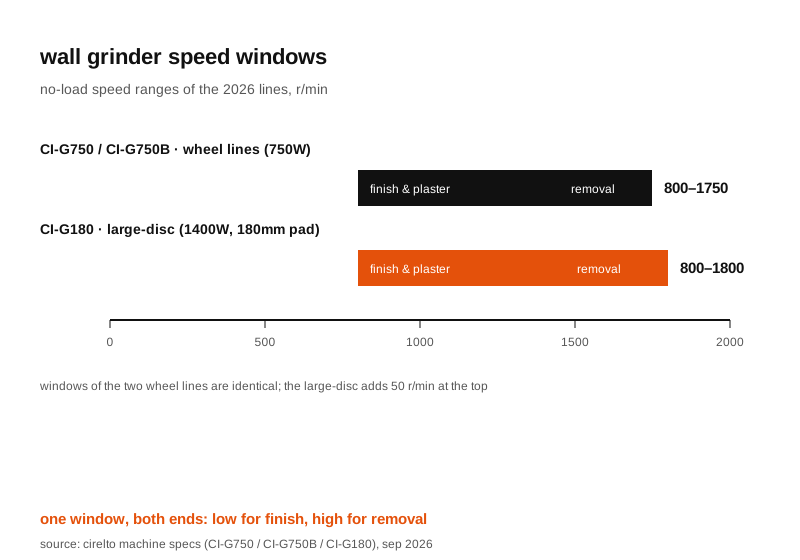
On Cirelto's wheel lines — the CI-G750 and its 4-wheel sibling CI-G750B — the no-load window runs 800–1750 r/min. The large-disc CI-G180 stretches the top slightly to 800–1800 r/min. Same working span, different bases; the number on the box describes the range the dial sweeps, and everything about how the machine feels at each end follows from it.
low range: plaster, putty and the finish passes
The bottom of the window is where wall work actually lives. Fresh plaster and putty skins quickly, and a fast pad digs through that skin into the soft material underneath — the classic burn-through that turns a flat wall into a repair job. Low speed with a fine grit and light pressure keeps the pad sweeping instead of digging: the abrasive shears the high spots off without loading up, and the shroud keeps the fine dust moving into the hose before it reaches the room.
A practical habit for crews: start low enough that the machine feels almost lazy, then raise the dial one step at a time until the wall — not the pad — tells you the rate is right. If the dust in the hose turns from fine to coarse, the grit is cutting rather than sanding; step back down.
high range: concrete, coatings and knockdown work
The top of the window belongs to removal. Hard coatings, heavy build-up, mortar splashes and concrete spots need pad energy to cut — at low speed those materials just glaze the abrasive. This is also where the machine's other numbers start to matter: the 1400W CI-G180 holds its 180mm pad through heavy passes better than a 750W wheel machine, and every line's shroud-and-hose extraction earns its keep, because high-speed work multiplies the dust load the shroud has to capture.
The discipline is the mirror of the low range: spend as little time up here as the job allows. High speed is a tool setting, not a work rate — crews that ride the top end all day go through abrasives and motors faster without finishing faster.
the second lever: pad pressure
Dial position is only half the speed story. The pad's cutting rate scales with pressure, and on a large pad a little goes a long way — pressing hard on a fast pad is how discs load up, walls get scalped and motors overheat. The trade's working rule: let the pad run at the speed the task needs and keep the pressure just enough for the abrasive to bite. Weight does part of the work by design — the wheel-based lines carry 3.6–3.9 kg to keep the head planted, while the 2.5 kg CI-G180 trades some of that downforce for one-hand overhead comfort.
one window across the 2026 lines
For a buyer, the speed spec compresses to a single line: every Cirelto wall grinder covers the same low-to-high working span, so the line choice is about base, weight and power — never about the dial.
How the two wheel bases split the same window is a base-design question, covered dimension by dimension in the 3-wheel vs 4-wheel wall grinder comparison. And because extraction is engineered into all three lines, the low-and-gentle end of the dial pairs directly with the capture rules in the dust-free wall sander and silica rules guide — the slower the pass, the less dust the system has to move. All three lines sit on the wholesale range, quotable side by side.
faq
What speed should a wall grinder run at for plaster?
The low end of the window — start near 800–1100 r/min with a fine grit and light pressure. Plaster and putty skins over fast, and an aggressive pass burns through the surface and loads the abrasive. Raise the dial only if the material refuses to come flat at low speed.
When do I use the top of the speed range?
For removal, not finishing: hard coatings, heavy build-up, concrete or masonry spots that need knocking down before the finish passes. High pad speed cuts faster but also generates more dust load and heat — which is exactly why the extraction shroud matters more as the dial climbs.
Why do wall grinders run 800–1750 r/min while grinders for metal run far faster?
Because the pad on a wall grinder is large — up to 180mm — and tip speed at the rim scales with both rpm and diameter. A wall grinder at 1750 r/min already moves its pad rim faster than a small angle grinder looks like it would, and a wall surface needs that energy spread over a wide pad, not concentrated. Slow and wide is the design; the range exists so one machine can do both ends of the work.
Do the wheel and large-disc lines share the same speed window?
Nearly. The CI-G750 and CI-G750B wheel lines run 800–1750 r/min; the large-disc CI-G180 runs 800–1800 r/min. The 50 r/min difference at the top is negligible in practice — all three lines cover the same low-to-high working span, and the choice between them is base design and weight, not speed.
match the window to your walls
plaster-heavy or concrete-heavy market? send the wall mix and we'll point at the line — and the speed habits — that fit it, from 10 pcs.
send the wall types