
electric mortar mixer buying guide: 1600W vs 2100W
Why do professional mixers spin slower than the drill in a hallway closet? Because mortar does not want speed — it wants torque. Cirelto (a wholesale power-tool supply brand from Wenzhou, China) builds both of its mixer lines around that idea: two power classes, one low-speed window. Here is how to pick between them for your market.
by peter zhang · sep 17, 2026
150–950 r/min is the window that matters
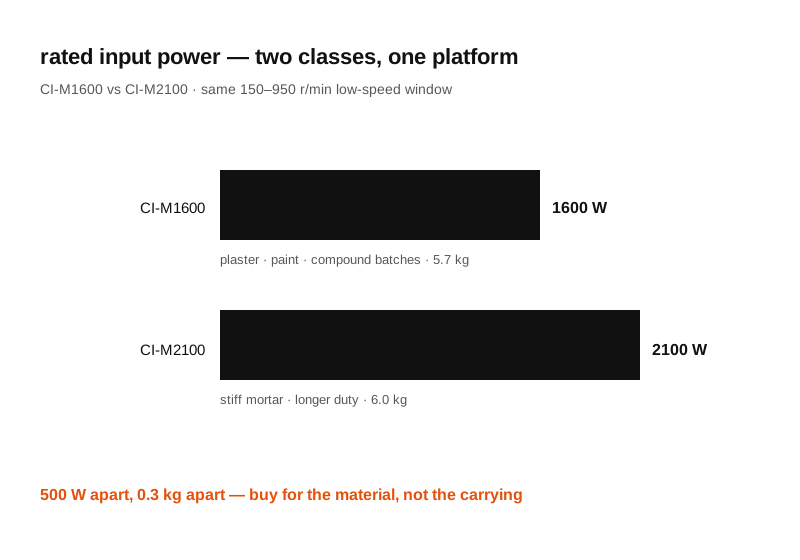
Both CI-M1600 and CI-M2100 run the same low-speed, high-torque range that folds mortar without whipping air into it. Choose 1600W for plaster, paint and compound batches; 2100W for stiff mortar volume. Weights are 5.7 vs 6.0 kg — nearly a wash.
why low speed wins mortar: the 150–950 r/min window
A high-RPM drill with a paddle attachment beats air into mortar and splatters it up the bucket. Mixing is a folding action, not a cutting one: the paddle has to move material from the bottom of the bucket to the top under load, which takes torque at low speed. That is the engineering logic behind the 150–950 r/min no-load window on both Cirelto mixers — slow enough to keep the batch in the bucket and the mix dense, fast enough to finish a batch in working time. For a crew, the same window is also the speed dial: low for paints and compounds, higher for mortar and plaster as the material stiffens.
CI-M1600 vs CI-M2100: choosing the power class
The two lines differ in exactly two spec lines: input power and net weight. The electric mortar mixer page lists both — CI-M1600 at 1600W / 5.7 kg, CI-M2100 at 2100W / 6.0 kg. Everything else is shared platform: 220V~/50Hz supply, the same 150–950 r/min window, the same M14 spindle. In practice the 500W gap is about batch character. The 1600W holds its speed comfortably through plaster, paint and compound batches; the 2100W is the class for stiff mortar and longer duty, where the extra headroom keeps the motor from bogging as the mix tightens.
spec sheet: one platform, two power classes
| spec | CI-M1600 | CI-M2100 |
|---|---|---|
| input power | 1600W | 2100W |
| voltage | 220V~ / 50Hz | 220V~ / 50Hz |
| no-load speed | 150–950 r/min | 150–950 r/min |
| net weight | 5.7 kg | 6.0 kg |
| spindle | M14 | M14 |
| materials | mortar · plaster · paint · compound | |
the M14 spindle turns a mixer into a platform
Both classes mount paddles on an M14 spindle — the thread standard across mixing tools. That makes the paddle side of the category a separate, high-churn SKU family rather than a bundled afterthought: the Cirelto M14 mixing paddle (CI-M14) comes in Ø120, 140 and 160mm head diameters and threads onto either mixer directly. Diameter choice follows batch size, not the mixer — the mixing paddle sizes explained guide matches each head to its material. Stocking mixers and paddles as one planned category is the margin play: the mixer sells once, the paddles sell for the life of the fleet.
5.7 and 6.0 kg on a full site day
At 5.7 kg and 6.0 kg, the two mixers are within 300 g of each other — close enough that weight should not drive the choice. Both are two-hand machines by design: the mixing action pulls against the operator, and the low-speed window is what keeps that pull controllable. If anything, note the counterintuitive purchasing rule that falls out of the spec sheet: because weight is nearly a wash, buy for the material, not for the carrying. A mortar-heavy market justifies the 2100W every time; a paint-and-plaster retail mix does not need it.
stocking mixers and paddles as one category
The commercial shape of the category is simple: one anchor machine, three paddle SKUs, repeat purchases on the consumable side. With the site-wide MOQ at 10 pcs per SKU, a first order can hold both power classes and all three paddle diameters — 10 + 10 machines plus paddles from 10 pcs each — without stretching the budget, and the mixed-container program consolidates the whole batch into one shipment. The product catalog lists the mixing line in full, and the wholesale from China guide covers sample, payment and shipping mechanics for first-time importers.
faq
Can the CI-M1600/2100 mix paint and joint compound too, not just mortar?
Yes. The applications list covers mortar, plaster, paint and compound mixing. The low-speed 150–950 r/min window is gentle enough for paints and compounds at the low end and torquey enough for stiff mortar at the top — one machine, four materials.
What spindle do the mixers take?
Both power classes use an M14 spindle — the standard thread for mixing paddles. The Cirelto CI-M14 paddles in Ø120, 140 and 160mm thread straight on; any other M14-threaded paddle fits the same way.
Should a first order take the 1600W or the 2100W?
Follow the material mix of your market. Plaster, paint and compound-heavy retail suits the CI-M1600 (5.7 kg); mortar-heavy construction markets suit the CI-M2100 (6.0 kg). The platform is otherwise identical, so many distributors open with 10 + 10 and let the repeat order pick the volume winner.
What are the MOQ, sample and OEM terms?
Site-wide MOQ is 10 pcs per SKU. Samples ship in 5-7 days via DHL/FedEx so you can mix real batches before committing. OEM private label runs from 50 pcs, with custom packaging available at the higher OEM tier.
size the mixer + paddle pair for your market
tell us what your crews mix — mortar, plaster, paint, compound — and we'll quote the power class and paddle heads to match, from 10 pcs.