
dust-free wall sander: how silica rules changed the job
Fifty micrograms per cubic meter is the number that changed wall sanding. That is the exposure cap for respirable crystalline silica in both the United States and the European Union — and drywall sanding sits squarely in its blast radius. This guide explains the rules behind the number, what a dust-free wall sander actually is, and how wholesale buyers stock the category from China as rules pull demand.
by peter zhang · sep 18, 2026
the 50 µg/m³ rule
OSHA's construction silica standard (29 CFR 1926.1153) and the EU's updated limit (Directive (EU) 2019/1300) both cap respirable crystalline silica at 50 µg/m³ as an 8-hour average. The equipment answer is a dust-free wall sander: a shrouded head with vacuum extraction.
silica dust, in one paragraph
Crystalline silica is the mineral in sand — and therefore in sand-based plaster, concrete and many fillers. Sand or grind those materials and the fine fraction that stays airborne is respirable crystalline silica: small enough to reach deep lung tissue, and the cause of silicosis, an incurable, preventable disease. Wall finishing generates exactly that dust, room after room. The health case is old; what changed in the last decade is that regulators on both sides of the Atlantic wrote numbers into law.
the two numbers: 50 µg/m³ on both sides of the Atlantic
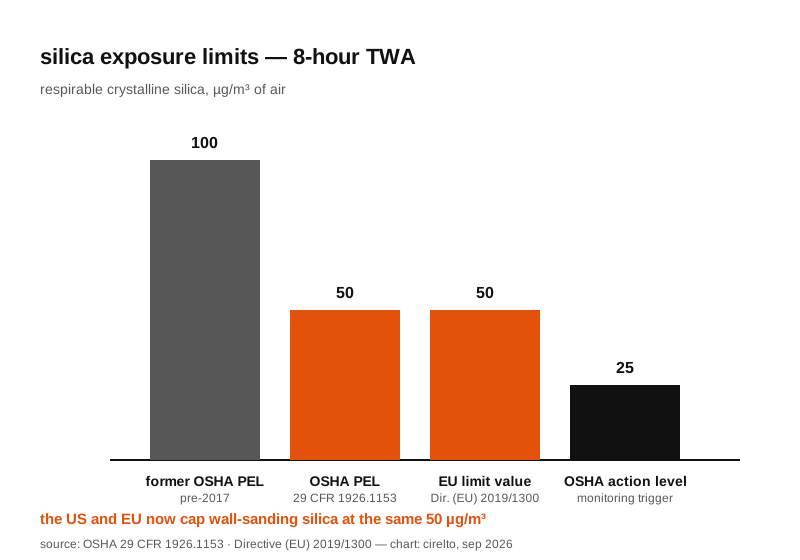
In the United States, OSHA's construction silica standard — 29 CFR 1926.1153, source: osha.gov — set a Permissible Exposure Limit of 50 µg/m³ as an 8-hour time-weighted average, half of the previous 100 µg/m³ limit, with an action level of 25 µg/m³ that triggers monitoring duties. The standard also contains a practical shortcut: Table 1, a list of equipment-and-task combinations that comply without personal exposure monitoring, as long as the specified dust controls run. For grinding and sanding tasks, those controls mean an enclosed shroud or hood and a vacuum system — HEPA-type filtration in the vacuum path is part of the Table 1 equipment recipe.
In the European Union, Directive 2017/2398 added respirable crystalline silica to the Carcinogens and Mutagens Directive with a binding limit of 0.1 mg/m³, and Directive (EU) 2019/1300 tightened it to 0.05 mg/m³ — 50 µg/m³ — in application since 2023 (source: EU-OSHA). Member-state law now carries that number into national construction practice. One number, two regulatory systems, same practical conclusion for the trade: capture the dust at the head, or measure and justify it. Measurement is expensive; capture is equipment.
what a dust-free wall sander actually is
Strip the category to its mechanics and it is two parts: a sanding head that runs inside a shroud — a skirt that encloses the abrasive and drops the dust trajectory — and a vacuum hose that carries what the shroud captures away at the source, before it becomes room air. That combination is what the wheel-based wall grinders ship as standard: the 3-wheel dust-free wall grinder CI-G750 and its 4-wheel sibling CI-G750B wrap their 750W, 800–1750 r/min heads in shroud-and-hose extraction, and the large-disc CI-G180 runs the same logic on a 180mm pad.
Two honest limits to state. First, "dust-free" describes the design intent — near-total capture at the head — not a zero-dust claim; site dust still depends on the vacuum the shroud is paired with and how the crew works. Second, the machine is one pillar of compliance: exposure assessment, vacuum specification and work practice remain the employer's side of the ledger. What the machine changes is that dust capture becomes the default rather than an afterthought bolted onto an open sander.
verify before you stock: the 4-point sourcing checklist
When comparing dust-free machines from Chinese factories, four checks separate the real category from the marketing:
1. Shroud and hose in the box, not the catalog. Extraction should be standard equipment on the SKU you are quoting — the Cirelto wheel models ship shroud plus hose on every unit. 2. Weight the crew can carry overhead. Dust rules push crews toward long sessions; 2.5–3.9 kg is the class that survives an eight-hour day. 3. A wide speed window. 800–1750 r/min covers plaster, putty and concrete passes without tool swaps. 4. Supplier terms that let you test first. MOQ 10 pcs per SKU and 5-7 day samples exist precisely so a distributor can verify capture quality with their own crews before the container order.
the distributor angle: regulation sells the category
For a wholesaler, the interesting property of a rule-driven category is that demand does not depend on taste. Every contractor that bids on regulated work has a reason to own extraction-equipped sanding gear, and the sales conversation writes itself: the limit is 50 µg/m³, enforcement exists, and this machine captures at the head. That is also why the wall grinder class splits so cleanly for stocking — 3-wheel vs 4-wheel for renovation or open-wall work, compared here — while the import mechanics, from MOQ floors to mixed-container freight, are the same playbook as any machine import: see the wall grinder import guide. The product catalog lists the three lines side by side.
faq
Is wall sanding dust actually silica?
Often, yes. Sand-based plaster, concrete and many fillers contain crystalline silica, and sanding or grinding them releases respirable dust. The safe trade assumption is that wall sanding produces respirable crystalline silica unless the material datasheet says otherwise — which is why the exposure limits below apply to the trade by default.
Does a dust-free machine alone make a job compliant?
No — and no supplier should claim it does. OSHA compliance runs on exposure assessment or a Table 1 control method, which pairs the machine with vacuum requirements; the EU directive adds assessment and health-surveillance duties for employers. Equipment is one pillar of the answer, and a shroud-plus-vacuum setup is the pillar a machine can deliver.
What does OSHA Table 1 require for wall sanding?
Table 1 lists equipment-and-task combinations that comply without personal exposure monitoring, provided the specified dust controls run — for many grinding and sanding tasks that means an enclosed shroud or hood with a vacuum system, with HEPA-type filtration in the vacuum path. A wall grinder with standard shroud-and-hose extraction is designed to slot into that pattern.
What MOQ applies to the dust-free wall grinder lines?
MOQ is 10 pcs per SKU across all three Cirelto lines — 3-wheel CI-G750, 4-wheel CI-G750B, large-disc CI-G180. Wheel models pack 4 units per carton. Samples ship in 5-7 days via DHL/FedEx, and OEM private label starts at 50 pcs.
stocking for a regulated market?
send your market's rules question with your machine list — we'll match the wall grinder lines and trial quantities to it, from 10 pcs.
send the machine list