
cami vs fepa grit: the wall-sanding range, mapped
Two warehouses, one order: "send 120, 180 and 220 pads." One ships sheets printed 120/180/220, the other P120/P180/P220 — and a buyer could be forgiven for wondering whether they just bought two different products. Cirelto supplies sanding pads for wall grinders wholesale from Wenzhou, China into both labeling worlds, and the short answer is reassuring: in the range walls are actually sanded in, the two standards nearly coincide. Here is the mapping, and the one place it stops holding.
by peter zhang · sep 26, 2026
in the wall range, a two-micron difference
P120 averages ~116µm vs ~115µm for CAMI 120; P180 ~82 vs ~80; P220 ~66 vs ~66. Same numbers, near-identical particle sizes — separate standards (ISO 6344 vs ANSI 74.18) that converge where walls are sanded and only drift apart at polish grades. Stock the label your market reads.
two standards, one wall
CAMI — the Coated Abrasives Manufacturers Institute system, now maintained under the ANSI 74.18 standard — is the North American grading. Sheets print bare numbers: 120, 180, 220. FEPA, the Federation of European Producers of Abrasives, grades coated abrasives on the P-scale defined in ISO 6344, and its products carry the P prefix: P120, P180, P220. The P-prefix convention dominates in Europe, the UK, Australia and most of Asia; bare numbers dominate in North America (abrasives standards references, Sep 2026).
Both systems grade by average particle diameter, which is why they can be put side by side at all — and why the comparison is about microns, not vibes.
the wall-sanding range in microns
Interior wall work lives between 120 and 220 grit — the sequence the dust-free sanding technique guide walks through pass by pass. Across exactly those three grades, the two standards line up within a micron or two:
| grade | FEPA P (µm) | CAMI (µm) | gap |
|---|---|---|---|
| P120 / 120 — flattening | ~116 | ~115 | <2% |
| P180 / 180 — feathering | ~82 | ~80 | <3% |
| P220 / 220 — finish | ~66 | ~66 | ≈0 |
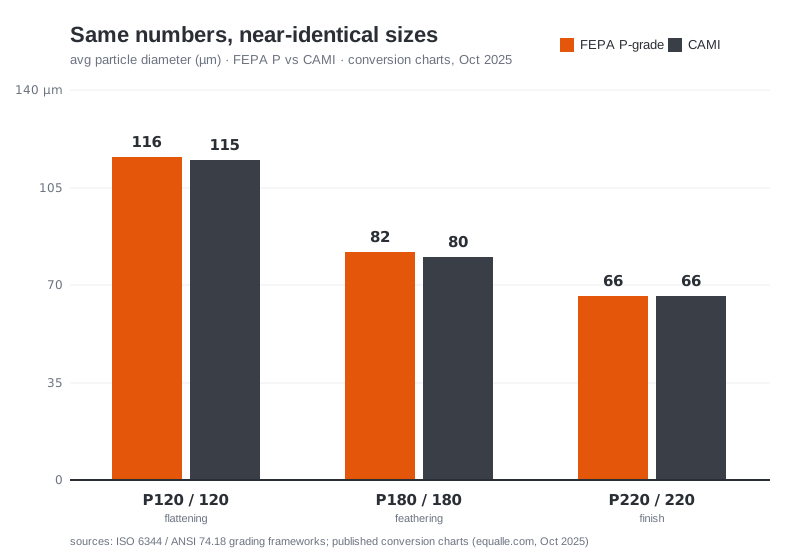
The differences that remain are about distribution rather than average: FEPA P-grades are cut to a narrower particle-size band, so an equal-label sheet cuts marginally more uniformly (conversion-chart references, Oct 2025). On a wall, under a vacuum shroud, at a moving 180mm pad — that margin is not what a finish reads. This is why the same 120-180-220 sequence runs unchanged whether the pads came from a CAMI or a FEPA warehouse.
where the scales drift apart
The convergence is a wall-range phenomenon, not a law. Past the finish grades — into the P400-and-up territory of furniture work, lacquer sanding and stone polishing — the two scales separate: the same number stops meaning the same micron value, and FEPA's P-scale extends far finer than CAMI's published range, out past P2500 for polishing work. A buyer who reads "800" across both labels at the polish end is comparing sheets a grade or more apart, which is where cross-standard stocking genuinely bites (abrasives conversion references, Oct 2025).
The practical rule for distributors: match microns, not numerals, whenever an order crosses the P-boundary — and for interior wall programs, order by the label your market expects to see printed.
stocking pads across both labeling worlds
The abrasive is the same disc; the printing is the market signal. A US-facing rack wants bare numerals, a European or Australian one wants P-prefixes — a customer who cannot tell which standard they are holding assumes the rack is disorganised, and the rack loses the sale before the abrasive gets tested. Distributors running the large-disc CI-G180 line carry 180mm hook & loop pads in both printings and split them by destination; the pads are a repeat-purchase line, so the label consistency pays back on every reorder, not just the first sale.
The full pad and accessory line — and how the consumables attach to each machine class — is covered in the wall grinder accessories guide. MOQ runs 10 pcs per SKU, so holding both printings of the same grit is a stock-keeping decision, not a volume one.
faq
Is P120 the same as 120 grit?
In the wall-sanding range, practically yes. P120 averages about 116µm per particle and CAMI 120 about 115µm — a difference under 2%. They are still separate standards: FEPA P-grades are defined in ISO 6344 with a narrower particle-size distribution, CAMI grades under the ANSI 74.18 system, so an equal-label sheet cuts marginally differently. At polish grades (P500 and finer) the two scales drift apart and are no longer interchangeable by number.
Which markets use CAMI and which use FEPA?
CAMI grading is the North American convention — bare numbers on US-labeled sandpaper. FEPA P-grades (the P prefix) are the European and Asia-Pacific convention, used across the EU, UK, Australia and most of Asia. A pad printed "180" reads as CAMI in Houston and as FEPA P180 shorthand elsewhere, so distributors serving both regions stock the same physical abrasive in two printings.
What grits does the 120-180-220 wall sequence use under each standard?
The same numbers on both labels: 120 flattens joints, 180 feathers transitions, 220 removes the scratch pattern before primer. Because P120/120, P180/180 and P220/220 sit within 1-2µm of each other in average particle size, the sequence produces the same finish whether the pads arrived from a CAMI or a FEPA inventory (published conversion charts, Oct 2025).
pads for both label worlds?
tell us your markets and grit list — the 180mm pad program quotes with both printings from MOQ 10 pcs per SKU, answers within 24 hours.
get the pad quote