
large-disc vs 3-wheel wall grinder: one pad or three wheels
These two lines sit next to each other in the same catalog and get bought for the same reason — finishing walls without a dust cloud. They are not the same machine. One is a 180mm pad sander that removes material across broad flat fields; the other is a shrouded grinding head that goes where a pad cannot. This comparison runs the numbers that separate them, and the assortment logic that follows for a wholesale buyer.
by peter zhang · sep 23, 2026
1400W on a pad, or 750W behind a shroud
CI-G180 gives you 1400W across a 180mm pad at 2.5 kg — the fastest flat-wall removal and the lightest machine to hold overhead. CI-G750 gives you 750W behind a shroud on three wheels, shroud and hose standard, for corners, edges and dust-managed passes. Stock both; lead with the one your market's work looks like.
the 1.1 kg question
Wall finishing is overhead work, and overhead work is a fatigue problem before it is a power problem. The weight spread across the range is small in absolute terms and decisive in practice: CI-G180 at 2.5 kg, CI-G750 at 3.6 kg, CI-G750B at 3.9 kg. A 1.1 kg difference does not sound like much on a spec sheet. Held above shoulder height for a six-hour shift, it is the difference between a crew that finishes a room and a crew that starts improvising with a stepladder and a hand block.
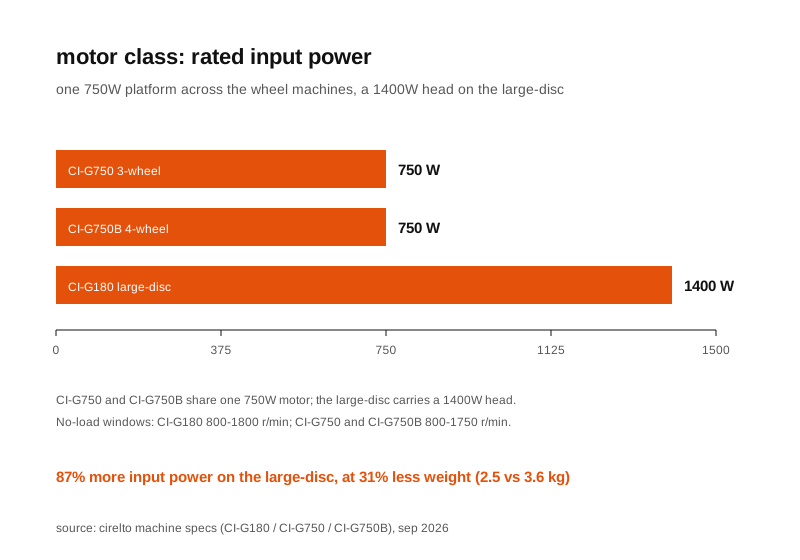
The counterintuitive part is which machine is lightest. The large-disc carries nearly twice the motor of the wheel machines and weighs a third less, because it does not carry a wheel carriage or a shroud assembly. That is the whole design trade in one number: the CI-G180 spends its mass budget on motor, the CI-G750 spends it on containment.
spec sheet: ci-g180 against ci-g750
| spec | CI-G180 large-disc | CI-G750 3-wheel |
|---|---|---|
| input power | 1400W | 750W |
| no-load speed | 800–1800 r/min | 800–1750 r/min |
| working surface | 180mm hook & loop pad | shrouded grinding head |
| net weight | 2.5 kg | 3.6 kg |
| supply | 220V~ / 50Hz | 220V~ / 50Hz |
| carton | on request | 4 units |
Read the two speed windows together and note how little they separate the machines — 800–1800 against 800–1750 r/min is the same working envelope with a rounding difference. Speed is not the differentiator here; the head is. That is why the buying decision should be made on surface geometry and dust strategy rather than on the dial, and why the individual line guides (the large-disc guide and the 3-wheel vs 4-wheel comparison) go deeper on each family than this pairing needs to.
where the large-disc wins
Broad, flat, uninterrupted wall. A 180mm pad covers roughly twice the contact width of a narrow grinding head, so the CI-G180 finishes a plastered wall field in fewer passes and flatter — the pad bridges small undulations that a small head would follow into the surface. Add 1400W and the removal rate stops being the constraint on the job. The applications list reads exactly that way: wall sanding, surface smoothing before painting, one-hand overhead work.
Consumables are the other half of the argument. Hook-and-loop abrasive pads are the most commoditised item in the whole wall-finishing category — a distributor who stocks the machine is stocking a tool whose refill is already on the shelf in their market, in whatever grit that market prefers. Nothing about the CI-G180 asks a buyer to change their consumables supply chain.
where the 3-wheel wins
Everything that is not a broad flat field. Corners, reveals, door heads, uneven or heavily filled plaster, and any pass where the material is hard enough that grinding beats sanding. The three-wheel carriage is what keeps the head stable on irregular surfaces, and the shroud is what keeps the dust from leaving the head — the CI-G750 ships shroud and hose as standard equipment rather than as an accessory, which matters on regulated work where the dust-control setup is the point of the purchase.
The 4-wheel CI-G750B is the same 750W motor and the same working envelope with a wider footprint for open-wall work, 0.3 kg heavier. If the choice inside the wheel family is still open, the 3-wheel vs 4-wheel comparison settles it on stability against footprint; for this pairing, treat the two as one answer.
stocking both: how a first order splits
The floor is 10 pcs per SKU, so a distributor can open with both lines without betting on either. A workable first split runs 20 pcs across the two: ten of the light pad machine for the finishing crews, ten spread across the wheel family for the grinding work and the corners. On the wheel side the carton holds 4 units, so that half of the order is three cartons; both lines consolidate at the Wenzhou warehouse into a single mixed shipment, which keeps it to one customs entry.
Then let the reorder tell you which market you are actually in. A distributor whose customers are repaint contractors will find the CI-G180 reorders first; one selling into renovation and remediation work will see the shrouded machines move. Neither answer is wrong, and the cost of finding out at 20 pcs is small next to the cost of guessing at container quantity. OEM private label opens at 50 pcs once you know which line earns the branding.
faq
Is the large-disc CI-G180 a wall grinder or a sander?
Both names fit, and the spec sheet is the tiebreaker. The CI-G180 drives a 180mm hook & loop pad at 1400W and 800-1800 r/min, so its working surface is abrasive paper on a broad flat head — a pad sander by mechanics. The CI-G750 and CI-G750B drive shrouded grinding heads on three or four wheels, which is the grinding configuration. The distinction decides consumables, not vocabulary.
Which line removes material faster?
The large-disc, on flat surfaces. It carries 1400W against 750W and spreads that power across a 180mm pad, so it covers wall area per pass that a narrower shrouded head cannot match. The wheel machines win wherever the work is not a broad flat field: corners, edges, uneven plaster and any pass where shroud extraction matters more than removal rate.
Why is the heavier machine easier to use overhead?
It is not — the wheel machines are heavier. CI-G750 is 3.6 kg and CI-G750B is 3.9 kg, against 2.5 kg for the CI-G180, a 1.1 kg gap. Overhead wall and ceiling work is grip-and-hold work, so the lightest machine in the range is the one a crew can run for a full shift without trading accuracy for fatigue.
Can I stock both lines in one first order?
Yes, and it is the common pattern. MOQ is 10 pcs per SKU rather than per order, the wheel models pack 4 units per carton, and both lines consolidate at our Wenzhou warehouse into one mixed-container shipment on 15-30 day ocean freight. Samples of either line ship in 5-7 days, so a distributor can test both before committing to the split.
still splitting the first order?
tell us what your customers actually sand — flat repaint work or renovation — and we'll suggest the split, with samples of both lines staged the same week.
ask for the split recommendation